February 24, 2022, Russia launches a military offensive against Ukraine, attempting to invade it.
Thousands of Ukrainians are leaving their country in search of a land of asylum. France is one of them.
July 2022, I leave Paris to settle in Nice. At the same time, a Ukrainian family fleeing the war moved in on the landing opposite, my new neighbors. This meeting touched me by directly confronting me with the condition of these people, forced to flee their country, their loved ones, their roots, their daily life.
“Nowhere Is Everywhere” presents refugees, men, women, children, most of whom have lost everything, left everything behind, some will probably never see their native country again.
Torn from their world, exiled, they must rebuild themselves in a place that they do not know, that they often have not even chosen, learn again, find new benchmarks. Language, work, administration, so many challenges, so many new sources of anxiety and isolation.
The pathologies caused by this forced exile are multiple. Homesickness is of course the first thing that comes to mind, having to leave your country in such a hurry leaves no one unscathed. Added to this are nostalgia, fear, helplessness, anger, sadness.
Then there is this feeling of loneliness, of isolation. Loneliness when faced with your family, with your friends that you no longer see, that you have lost or of whom you have little or no news. Isolation from your past, your life before. Loneliness in the face of his new daily life, the feeling of not being at your place either here or elsewhere. This loneliness that inhabits you, that eats away at you like a cancer.
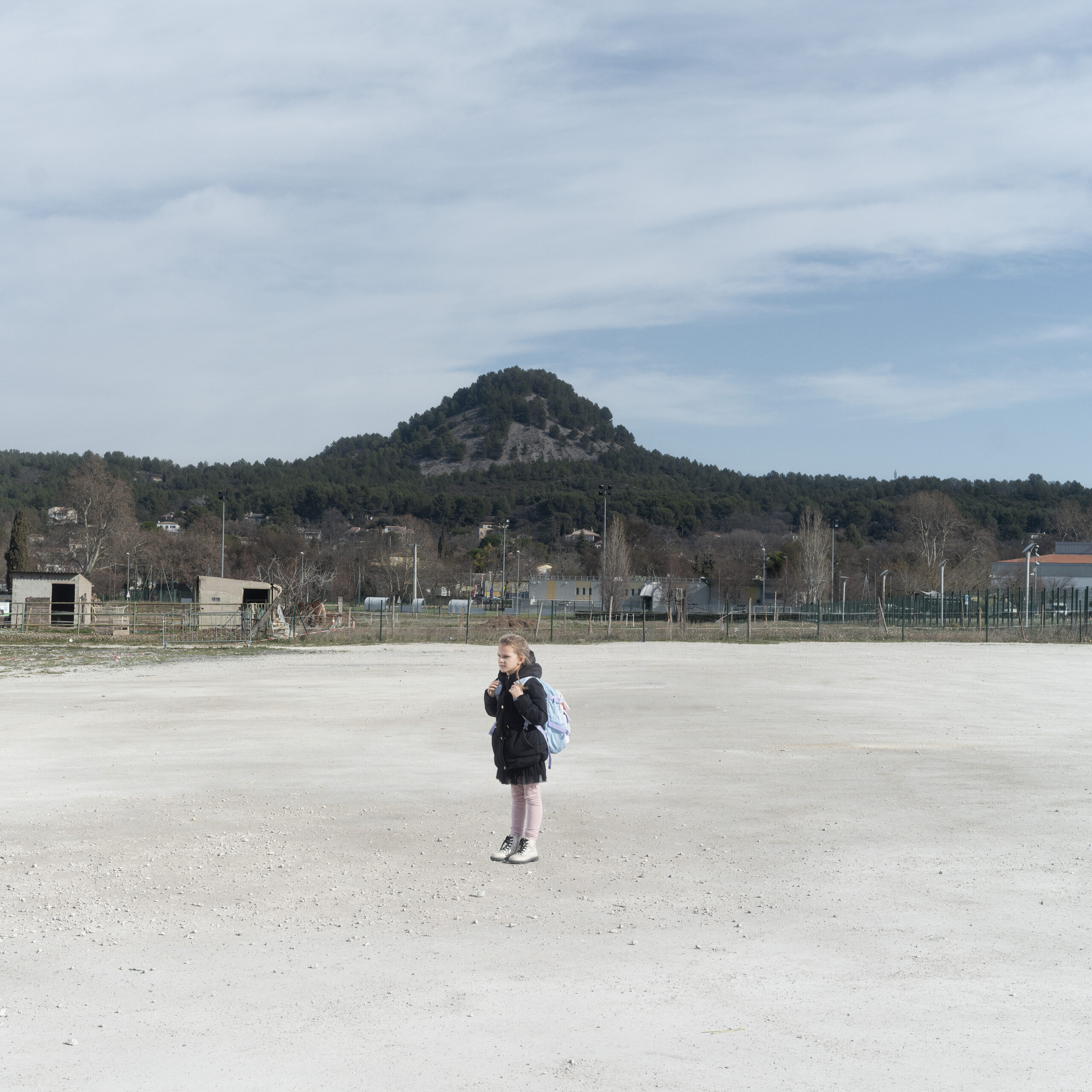
My work does not seek to bear witness to the new living conditions of these people. Its intention is to highlight the loneliness and isolation that inhabit them and tend to increase in intensity over time for some of them.
Also, I present them alone, decontextualized, facing themselves, facing the immensity of what they have to accomplish. Because even if we are surrounded, we remain alone in the face of our inner traumas and this uprooting.
As if teleported into a new world that they discover, alone facing the challenges that are now theirs and that they must face daily, facing their past, while having to coexist, for some of them, with the feeling that they abandoned their homeland, their loved ones, their friends, like deserters, or worse, enemies.
The photographs, staged, illustrate rather than testify, photography seen as hyperbole of a reality often ignored.
The image, to perhaps accept yourself a little more, to translate with your own means what you feel and which you cannot express in words that your interlocutors often do not understand.
An image to tell a story.
Between resilience and suffering, these photographs also question us about our view of refugees, of these people about whom we know nothing and whose fate and history have forced them to leave their homeland; these people from whom our gaze so often turns away without seeking to know or understand.
March 2024: after a year of working with refugees it appears more and more clear to me that an element is missing from my thinking, from my work. Meeting these refugees naturally leads me to wonder and take an interest in their loved ones, in those who stayed.
What is it like to see a family member go abroad, start everything from scratch, in an environment that neither of them knows?
This feeling of the distant, the unknown, the absence.
A refugee told me “after two years in France I changed, but my city has not changed except for the cemetery which has filled up considerably; I no longer feel at home there”
Reflecting an established reality, I will question the evolution of these destinies; those who have left whose lives are disrupted by departure but also by life in another country, another culture, another society, by the daily worry of seeing their loved ones affected by the horror of war and those who remained, making facing the daily difficulties of war, fear, absence and separation.
I felt this need to meet the families and loved ones of the refugees that I had been photographing for a year.
I therefore decided to go to Ukraine to meet them.
It will be a question of photographing throughout the country the families or loved ones of the refugees who were the subjects of the first part, thus bridging two worlds separated by war.
So I left with my car and my equipment in order to be able to continue working in the same way, to light my scenes, to feature these people who remained in Ukraine in order to be able to illustrate my point.